Thursday, 21 November 2013

Thursday, 14 November 2013
Monday, 11 November 2013

Sunday, 27 October 2013
Research & Planning - Teenage Cancer Trust News Article
I came across this newspaper article today which marks the start of Teenage Cancer Action week. It aims to make children and young people aged 13 to 24 more aware of the five most common signs of cancer in their age group. This shows that my chosen topic is relevant and it is trying to get more publicized. I feel that my documentary will help to do this.


Friday, 25 October 2013
Research - TV Times

Thursday, 3 October 2013
Research & Planning - Branding Articles
Here are links to articles about branding which I found particularly interesting:
Article relating to Pretty Little Liars
Article relating to Taylor Swift
Article relating to branding the BBC
Article relating to Pretty Little Liars
Article relating to Taylor Swift
Article relating to branding the BBC
Research & Planning - 7 Killers Facts About Advertising
There's been a lot of intriguing research into how TV advertising works and why. Thinkbox carried out this research.
Thursday, 26 September 2013
Research & Planning - Codes And Conventions Of Documentary
During my research, I found a video which included the codes and conventions of a documentary. This has helped me when filming to ensure that I include the codes and conventions of a documentary.
Thursday, 19 September 2013
Research & Planning - What makes a good short film?
I have conducted some research on short films and what makes a good, effective short film. The below website I found very useful and I know it is from a good, reliable source (BBC) so I will take some tips from here. The top tips from this website on what makes a short film is:

http://www.bbc.co.uk/filmnetwork/filmmaking/guide/introduction/what-makes-a-good-short
- An Exciting & Original Idea
- A Strong Script
- Good Acting
- High Production Values
- Make It Short
- A Strong Beginning
- Avoid Repetition & Punchline Twists
- Exciting New Techniques & Style

http://www.bbc.co.uk/filmnetwork/filmmaking/guide/introduction/what-makes-a-good-short
Research - Short Films
I have also found the above short film which is very different to the previous video yet is still very effective. This short film has won three awards and two different festivals.
Sunday, 15 September 2013
Saturday, 14 September 2013
Research - Eddie Izzard: Marathon Man
I set out to run 27 marathons in 27 days as a tribute to Nelson Mandela and his 27 years spent in prison.
Having completed 4 marathons, unfortunately, I have had to put my attempt on hold due to unforeseen medical complications that have arisen due to a multitude of factors including severe terrain, humidity and altitude. But I wish to say that my attempt is not over and I will return to South Africa and run the 27 marathons and finish this story.
I owe that to Nelson Mandela who has inspired the world to struggle and succeed no matter what obstacles are thrown at us. - Eddie Izzard
As the marathons are run, we will be filming a documentary about Nelson Mandela's life and I will be talking to people who know him and who struggled with him over those 27 years. This documentary will be broadcast on Sky TV in the UK and is being sold to countries all around the world" - Eddie Izzard
Research - Learning About Film
It was recommended that I looked at the learning about film website to help me with my filming. Click here to visit this website. From this website, I learnt that:
- I shouldn't try and fit everything into one shot. Use different shots to show different things.
- Sound is as important as pictures. Unless you’re making a silent film, you should pay at least as much attention to sound as you do to the images.
- There are lots of ways to use sound. You can use sound to help show where and when the film is set, draw attention to important things, create an atmosphere or set a mood, depict a character, warn that something is about to happen.
- I should show something new with each shot. Show something different, or show a different view of the same thing.
- I should get the pace right. Don’t make your shots too short so that they just flash by, or so long that the audience gets bored.
- I should shoot in one direction, then in the opposite direction. If you do this, it makes the editing look less obvious. It also means that you can show a person and what they’re looking at, or two people together, using closeups. This gives the film more impact.
This research will help me with the filming process, as well as editing.
Thursday, 5 September 2013
Research & Planning - First Look At Footage
In today's lesson, I uploaded my footage which I recorded over the summer onto iMovie. I started to sort out what clips are suitable and clips that aren't.

My footage that I have recorded were taken at Hockley Woods and at my address. The image below shows where this is located.

Monday, 2 September 2013
Research & Planning - Story Boards
These story boards show my initial idea. The story boards have helped me consider different shot types and angles as well as the length of different shots before actually starting any initial filming.


Tuesday, 27 August 2013
Research & Planning - Brighton Marathon & Teenage Cancer Trust

- The Brighton Marathon is a road race run over the distance of 42.195 km or 26 miles and 385 yards.
- It takes place each April in Brighton on the south coast of England.
- The inaugural Brighton Marathon was organised by former international athlete Tim Hutchings and former Brighton club athlete, Tom Naylor. The first running of the race took place on 18th April 2010.
- The race opened to 12,000 entries, with 7,589 participating on race day.
- The course start line was at Preston Park. The route took in some of the sights of central Brighton before heading East towards Rottingdean.
- The race then headed west out to and around Hove, before returning on the seafront and finishing on Madeira Drive, close to Brighton Pier.
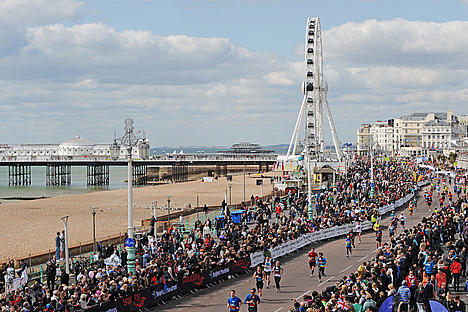
- In Year 2 (April 2011), over 8,000 runners took part with spectator numbers estimated at around 120,000. The race has acquired the status of “Britain’s No. 2 marathon” for its profile in the national running arena, for its standard of race organisation and for the publicity generated by the event.
- The 2012 event has seen a 20% increase on entries to an acceptance of 18,000, putting it in the top 12 running events in the UK. In September 2011.
Teenage Cancer Trust

- Teenage Cancer Trust is a charity that focuses on the needs of teenagers and young adults with cancer, leukemia, Hodgkin’s and related diseases by providing specialist teenage units in NHS hospitals.
- The units are dedicated areas for teenage and young adult patients, who are involved in their concept and creation. Medical facilities on the units are colourful and vibrant environments, equipped with computers, TVs, game consoles – designed to be places where friends and family feel comfortable to visit.
- The charity has units in London, Leeds, Liverpool, Birmingham, Sheffield, Newcastle, Manchester, Glasgow, Southampton, Edinburgh Cardiff, Bristol, Cambridge, Hull, Leicester and Nottingham.
- The charity also serves as an advocate for teenage cancer needs, becoming instrumental in the establishment of related research and national and international forums.
- It also provides support services and education related to teen cancer.
Statistics
- Every day in the UK, seven young people aged 13 to 24 are told they have cancer. That’s about 2,100 young people a year.
- Cancer is the number one cause of non-accidental death in young adults in the UK.
- One in 312 males and one in 361 females will get cancer before they are 20.
- Boys up to the age of 15 have a one in 450 chance of developing cancer, rising to one in 208 by the time they reach 24. Girls up to the age of 15 have a one in 517 chance of developing cancer, rising to one in 239 by the time they reach 24.
- Different cancers predominate at different ages: leukaemia, lymphomas and brain tumours in 13 to 18 year-olds, and lymphomas, carcinomas (soft tissue cancers) and germ cell tumours (e.g. testicular cancer) in 19 to 24 year-olds.
- Incidence rates are now higher in 13 to 24 year-olds than in children, yet survival rates for this age group have not improved as much.
- In England, five year survival stats for teenage and young adults (TYA) are approximately 69% for males and 73% for females. However due to the spectrum of tumours arising in teenagers and young adults this varies from 89% for male germ cell tumours (e.g. testicular), to 42% for males with Leukemia and 46% for bone sarcoma.
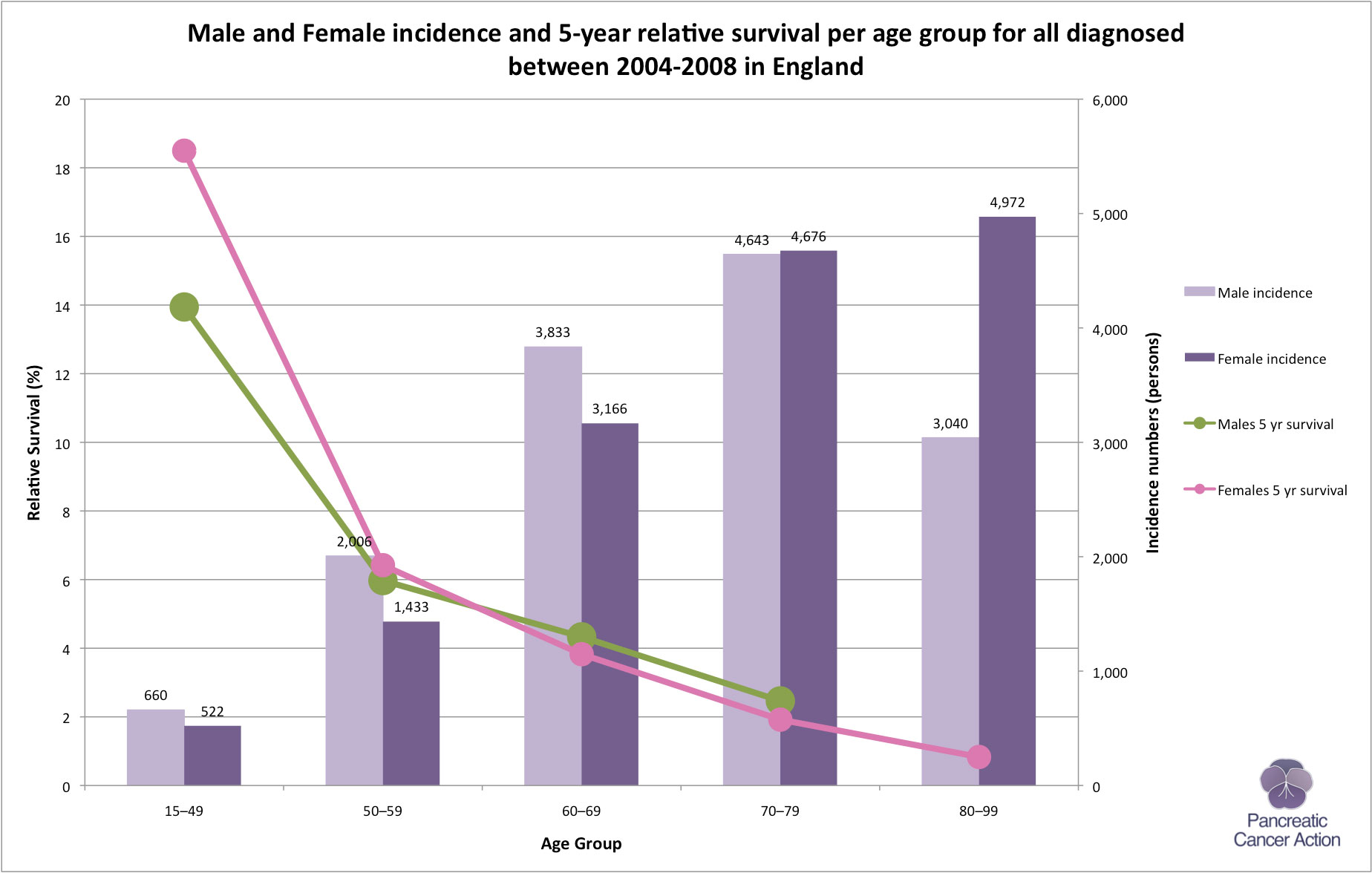
- Young people get some of the most aggressive cancers. But because only 0.6% of all cancers occur in young people, they are often misdiagnosed initially. This decreases their chances of survival and can mean they are excluded from clinical trials.
- 61% of young people with cancer felt their diagnosis could have been made quicker. 21% of young patients reported that their GP’s did not refer them to a specialist at all, despite almost 59% presenting at least two of the most common cancer symptoms: pain, lump/swelling, tiredness, headache or drastic weight loss.
Click here to be directed to a very inspiring article about The Teenage Cancer Trust.
Sunday, 25 August 2013
Research & Planning - Postmodernism & Intertexuality
- Postmodernism is when one text references another and how the references influence the audiences' perceptions and interpretations. It involves the breaking down of barriers.
- Postmodernism is typically known for challenging standard norms and values.
- Intertextuality refers to the linkage across texts or discourse events (where one text refers to the other)
- A print example of this is when an artist uses a well known phrase to title their album cover. The Stereophonics used the widely known war statement 'Keep Calm And Carry On' for their seventh studio album title.


- Morrisey's "Everyday is Like A Sunday" uses intertextuality throughout his video. For example; Morrisey's strong vegetarianism beliefs are shown through the girl writing "meat is murder" on the postcard.
Research & Planning - The Beginning Of Film

- The Lumière Brothers - 1890s
- The Lumière Brothers were the ground breakers of film.
- They came from Lyon in France, where they worked in their father's photographic factory.
- In 1894, they saw Edison's kinetoscope in Paris, and decided to design a camera of their own.
- By Feburary of the next year, they had produced a working model of their ciné camera, which called they a cinématographe.
- The films produced by the Lumieres' camera were usually about 50 seconds long.
- They mainly produced "actualities", a reflection of everyday life, mini documentaries
- Silent films are useful to look at, showing an evolution of visual language and grammar of film that formed the codes and conventions of today.
George Méliès - 1902
- Was a French illustionist and filmaker
- Famous for leading many technical and narrative developments
- George and his brother created the film "Le Voyage Dans La Lune" (A Trip To The Moon)
- The film was a black and white silent science fiction film
- The film runs at 14 minutes at a frame rate of 16 frames per second
Sunday, 11 August 2013
Research & Planning - Background Music Ideas
I heard this song being played on TV and believe it is appropriate for my documentary. The song starts slow but then the pace picks up almost creating a journey. I am going to consider using this song for my documentary.
Thursday, 18 July 2013
Research & Planning - Examiners Report January 2013
- Some real excellence and technical flair at the top end of the moving image work but, interestingly, work from a wider range of candidates seem to have benefited from moving away from low end video cameras towards DSLRs. DSLR cameras appears to have increased the quality of candidates' production work.
- Moving image work made very good use of sound, many creating their own diegetic and non-diegetic soundtracks, doing foley work etc.
- Original images were clearly used.
- There were several centres in which the ancillary tasks appeared to have been given insufficient attention in terms of the preparation of candidates' skills, confidence with relevant software as well as research and planning.
- Font choice seemed to be weak, with many candidates seemingly taking little time to consider suitable fonts for the genre.
- Candidates generally needed to take more test photographs and consider framing, lighting and mise en scene so that they had better images to work with.
- Some excellent examples of detailed textual analysis research for all three texts, and audience research which informed the planning. Research into existing media texts was more comprehensive in this series than in the past.
- Evaluations were generally relevant and were usually organised as discrete responses to each of the set questions.
- Work was generally submitted promptly by centres and with the correct paperwork.
- The majority of centres had taken note of previous moderation reports and created blog hubs for the submission of candidates’ work, which is excellent practice.
Research & Planning - Running Dates - Logistics Of Filming
I have carried out some research and found out potential dates in which I could film footage:
For these shoots, I will need the video camera and a tripod. To get to these places I will need to buy a travel card. I will not need to use any props as they will be provided at the fun runs such as: runners, water, charities, runners families and medals. I will primarily focus on shooting the runners as this will be my main focus point and also the hardest to shoot if not at a fun run.
- London Victoria Park 5K Run - Saturday 12th October
- Capital Runners Bushy Park 10K - London - 28th July 2013
- Self-Transcendence 5K - London - 29th July 2013
- Self-Transcendence 10K - London - 3rd August 2013
- Regents Park Race - 10K - London - 4th August 2013
- Self Transcendence Relay - London - 5th August
- Capital Runners - Richmond Park - 10K - 11th August 2013
- Greenwich Park - BHF - London - 17th August 2013
- Clapham Common Series Race - 18th August 2013
- Beat The Banana - Hyde Park - 5th September 2013
- 5K Run Challenge - Victoria Park - 12th September 2013
For these shoots, I will need the video camera and a tripod. To get to these places I will need to buy a travel card. I will not need to use any props as they will be provided at the fun runs such as: runners, water, charities, runners families and medals. I will primarily focus on shooting the runners as this will be my main focus point and also the hardest to shoot if not at a fun run.
Wednesday, 17 July 2013
Research & Planning - Modes Of Documentary
Nichols - identified five different modes:
Expository
Observational
Participatory (Interactive)
Reflexive & Performative
Documentary V Fiction
Function Of Documentary
Expository
- Mostly used in TV
- Voiceover narration, commenting & explaining in a direct address. The aim is to inform. I may use voice overs in my documentary.
Observational
- 'Fly On The Wall'
- Attempts to show the world as it is
- Long takes, handheld camera - no interview or voiceover
- The audience should be not aware of the filmmaker
Participatory (Interactive)
- The filmmaker is foreground in the participatory mode
- Its made explicit that the film is made from the point of view
- Often they are central character & their interaction & questioning of the subjects, lead the tone of the documentary
- Handheld camera, informal interviews
Reflexive & Performative
- Reflexive reveals how documentaries are produced as representations based on the construction & manipulation of the image
- The performative explicitly challenges the idea of documentary truth
- Reality-soap a new hybrid category
Documentary V Fiction
- There will always be an element of editing and therefore structuring devices
- Establish a 'problem' or dilemma to be eventually resolved
- Real people become characters
Function Of Documentary
- Used to be that it should be educational and enlighten the audience
- Grierson - documentary could perform a democratic function, educating the ordinary citizen about wider social, political and cultural developments.
Friday, 12 July 2013


Research & Planning - Codes & Conventions Of A Documentary
Codes & conventions of a documentary:
The voiceover will usually be authoritative in some way, encouraging the audience to think that they either have some kind of specialist knowledge or the 'right' opinions that the audience should pay attention to.
Documentaries often go to great lengths to convince us that the footage is real and unaltered in anyway, although editing and voiceover can affect the 'reality' we, as viewers, see.
To aid authenticity and to add further information which the film maker may be unable to obtain themselves.
Used to authenticate the views expressed in the documentary. Sometimes, they will disagree with the message of the documentary, although the film maker will usually disprove them in some way.

- Voiceover
The voiceover will usually be authoritative in some way, encouraging the audience to think that they either have some kind of specialist knowledge or the 'right' opinions that the audience should pay attention to.
- 'Real' footage of events
Documentaries often go to great lengths to convince us that the footage is real and unaltered in anyway, although editing and voiceover can affect the 'reality' we, as viewers, see.
- Archive footage/stills
To aid authenticity and to add further information which the film maker may be unable to obtain themselves.
- Interviews with 'experts'
Used to authenticate the views expressed in the documentary. Sometimes, they will disagree with the message of the documentary, although the film maker will usually disprove them in some way.
- Use of text/titles
- Sound
- Visual coding
- Technicality of realism

Research & Planning - Road To Yakima
Research & Planning - Father's Marathon Dream
Thursday, 11 July 2013
Research & Planning - Feedback From Pitching Ideas
Below, is the feedback I received from my peer group from the idea that I pitched to them for my coursework. I will take this feedback into consideration to improve my coursework idea. I will keep referring to my focus group throughout the process.

Wednesday, 10 July 2013
Research & Planning - Last Year's Work
Today, we have been looking at previous candidates work to gain inspiration and also good elements as well as bad elements. I have decided to blog these to help me improve my work and benefit my own production:
- Ensure that the editing style is matched to the genre. For example, if the genre is horror, make the production seem like a horror. The editing process is extremely important.
- Use a tripod for stable camera movement when necessary. A handheld camera may be used if necessary.
- If producing a documentary, include statistics and interviews. If producing a horror trailer, use close ups to create tension.
- Use composition techniques such as the Rule Of Thirds. Look for frames within a frame.
- Use music that is suited to the genre.
Research & Planning - Video Ideas - Diary
Research & Planning - London Marathon 2013 ideas
I have been researching documentaries and I have found the video above very inspiring. As I am running the Brighton Marathon 2014, I believe this would be a great opportunity to base my documentary on something related to that. I will continue to research some more documentaries to gain some ideas and inspiration for my documentary. In this video, I particularly like the personal element with different individuals all running for different people.
Monday, 24 June 2013
Research & Planning - Film Notes
The 180 Degree Rule
The 180 degree rule is a basic guideline in film making that states that two characters (or other elements) in the same scene should always have the same left/right relationship to each other. If the camera passes over the imaginary axis connecting the two subjects, it is called crossing the line. In the example of an action scene, such as a car chase, if a vehicle leaves on the right side of the frame in one shot, it should enter from the left side of the frame in the next shot. Leaving from the right and entering from the right will create a sense of disorientation.
The Dramatic Arc
The Dramatic Arc is one of the most popular and recognizable narrative structures in Western culture.

Eye-Line Match
An eye-line match is a film editing technique with the continuity editing system. It is based on the premise that the audience will want to see what the character on screen is seeing. The eye-line match begins with a character looking at something off screen, followed by a cut to the object or person at which he is looking. For example, a man is looking off screen to his left, and then the film cuts to a television that he is watching.
The 180 degree rule is a basic guideline in film making that states that two characters (or other elements) in the same scene should always have the same left/right relationship to each other. If the camera passes over the imaginary axis connecting the two subjects, it is called crossing the line. In the example of an action scene, such as a car chase, if a vehicle leaves on the right side of the frame in one shot, it should enter from the left side of the frame in the next shot. Leaving from the right and entering from the right will create a sense of disorientation.
The Dramatic Arc
The Dramatic Arc is one of the most popular and recognizable narrative structures in Western culture.
Eye-Line Match
An eye-line match is a film editing technique with the continuity editing system. It is based on the premise that the audience will want to see what the character on screen is seeing. The eye-line match begins with a character looking at something off screen, followed by a cut to the object or person at which he is looking. For example, a man is looking off screen to his left, and then the film cuts to a television that he is watching.
Wednesday, 19 June 2013
Subscribe to:
Posts (Atom)